Published July 31, 2026 · Reviewed by the Kendi Markanda Perfume production team
What does private label candle manufacturing include?
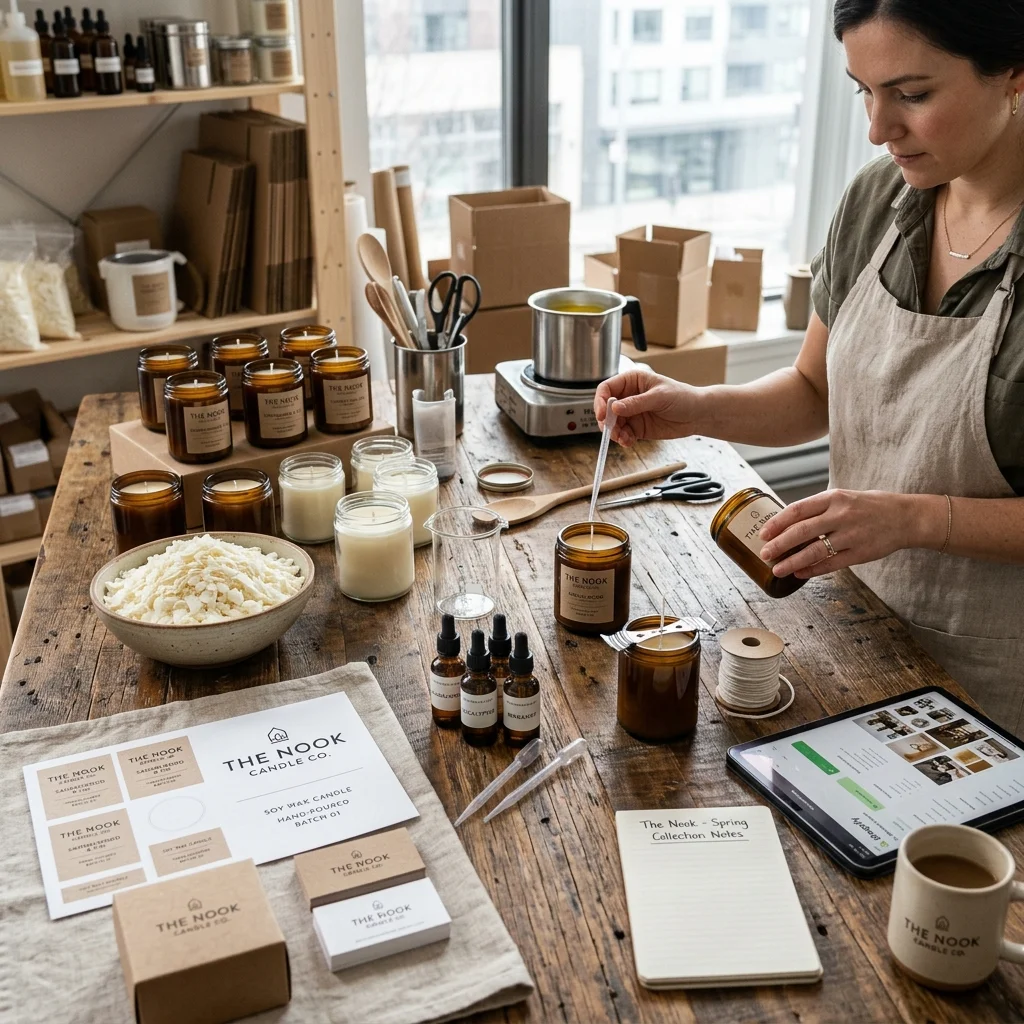
A turnkey candle project can include:
- Fragrance selection or development
- Wax-system selection
- Wick testing
- Jar or tin sourcing
- Colour selection
- Label and box design
- Filling and curing
- Burn-performance testing
- Batch coding and quality control
- Gift-set assembly
- Export packing
The brand owns the visual identity and commercial concept, while the manufacturer manages production. The level of customisation can range from a stock jar with a printed label to a decorated vessel, custom lid and premium rigid box.
Wax options
Soy and vegetable wax blends
Soy-based and other vegetable wax blends are popular for lifestyle positioning and a soft appearance. Performance varies by formulation. The marketing term “soy candle” should accurately reflect the composition and the rules of the target market.
Paraffin and mineral wax blends
Paraffin-based systems can provide strong fragrance performance and a smooth finish. A well-designed candle should be evaluated by performance and safety rather than by simplistic assumptions about one wax type.
Blended wax systems
Many commercial candles use blends to balance adhesion, surface appearance, fragrance throw, hardness, burn time and production consistency.
The best wax is the one that works with the fragrance, wick, jar and intended climate while supporting the brand’s position.
Why wick selection is critical
The wick controls how fuel is delivered to the flame. A wick that is too small may tunnel, self-extinguish or produce a weak melt pool. A wick that is too large may create excessive flame height, soot, rapid consumption or high container temperatures.
Wick selection depends on:
- Vessel diameter
- Wax type
- Fragrance load
- Dye or pigment
- Fragrance composition
- Number of wicks
- Intended burn duration
A wick chart is only a starting point. Final selection requires testing in the actual candle.
Fragrance development for candles
Candle fragrance must be evaluated for both cold throw and hot throw. Cold throw is the scent perceived when the candle is unlit. Hot throw is the scent released during burning.
A fragrance that smells strong in the bottle may perform poorly in wax. Some materials can also affect colour, surface finish or wick behaviour. The safe and technically suitable use level should be established for the intended candle category.
An IFRA Certificate of Conformity for the fragrance mixture can support safe-use planning, but it does not replace finished-product testing or legal compliance.
Jar and vessel selection
The vessel must be suitable for candle use. Decorative glass that was designed for food or cosmetics is not automatically suitable for repeated candle heating.
Consider:
- Heat resistance
- Wall thickness and consistency
- Diameter and shape
- Stability on a flat surface
- Label area
- Lid fit
- Shipping protection
- Availability for repeat orders
For premium brands, the vessel may be frosted, coloured, screen printed or decorated. Decoration should be evaluated for heat and handling.
Candle development and manufacturing process
- Define the commercial concept
Clarify the target customer, retail price, jar size, fragrance family, burn-time goal and packaging position.
- Select the wax, vessel and fragrance
These decisions must be made together because changing one can require a different wick.
- Conduct wick and burn trials
Several wick sizes may be tested. The evaluation should include repeated burn cycles rather than only the first lighting.
Looking for manufacturing for your brand?
Share the product, quantity and target market; we will prepare a project-specific quote.
- Approve visual design
The label, warning information, box and gift-set structure are prepared after the vessel is confirmed.
- Produce a finished sample
The sample should represent the final wax, wick, fragrance, colour, jar, label and box.
- Manufacture and cure
Wax is melted and processed according to the formula, fragrance is incorporated under controlled conditions and candles are poured. The products are then allowed to set and cure before final evaluation and packing.
- Quality control
Checks may include fill weight, wick centring, surface appearance, jar condition, label position, lid fit and batch identification.
What is the MOQ?
Kendi Markanda Perfume can plan private label scented candle projects at 500 units per fragrance and per container model, with the selected vessel, lid, fragrance wax and packaging.
Custom-coloured glass, special lids, individual boxes or printed rigid packaging may have higher supplier minimums. A standard jar with a high-quality label is often the most efficient starting point for a first collection.
What affects private label candle pricing?
- Wax type and fill weight
- Fragrance and use level
- Wick number and type
- Jar, tin or ceramic vessel
- Lid material
- Vessel decoration
- Label finish
- Folding carton or rigid box
- Protective inserts
- Quantity per fragrance
- Manual gift-set assembly
- Testing and documentation requirements
Private label candle costs vary widely between efficient standard formats and large premium vessels with luxury packaging. A useful quotation must describe the complete specification rather than only the fill weight.
Burn-testing checkpoints
A professional test program should consider:
- Flame height and stability
- Soot or visible smoke
- Wick mushrooming
- Melt-pool development
- Tunnelling
- Container temperature
- Fragrance throw
- Total burn behaviour
- Self-extinguishing near the end of life
- Label and decoration condition
User instructions and warning labels do not replace safe product design. They form one part of the overall safety system.
EU CLP and candle labelling
Scented candles can be treated as chemical mixtures under EU CLP rules when the final composition meets hazard-classification criteria. Classification may be influenced by the fragrance mixture even though the product is a solid candle.
Where applicable, the product may require CLP label elements such as hazard statements, precautionary statements, pictograms and supplier information. The final candle—not only the fragrance oil—should be assessed. Packaging and label design should therefore remain flexible until classification is complete.
Separate consumer-safety warning practices may also apply. The importer or brand owner should confirm the destination requirements before placing the product on the market.
Shipping and climate considerations
Candles can soften, sweat, crack or change appearance when exposed to high temperatures. Export projects should consider:
- Summer transport conditions
- Warehouse temperature
- Direct sunlight
- Protective inserts
- Glass breakage
- Lid security
- Carton compression
A product designed for a cool European climate may require additional testing for Gulf-region storage and delivery.
Common mistakes
Choosing a fragrance before defining the wax system
Fragrance performance is different in each wax.
Approving only a cold sample
The candle must be burned repeatedly to evaluate performance.
Selecting a decorative jar without candle suitability
Vessel appearance is not evidence of heat performance.
Using one wick for every fragrance
Different fragrances can alter burn behaviour even in the same jar.
Printing packaging before compliance review
Hazard and warning information can affect the design and available label space.
Frequently asked questions
Can I launch several candle fragrances in one jar?
Yes. Shared jars, lids and boxes can simplify the first collection, but each fragrance should be tested because it may require a different wick.
Can you make soy candles?
Soy-based and blended vegetable-wax options can be evaluated according to the required performance and market positioning.
How long should a candle cure?
The appropriate curing period depends on the wax and fragrance system. The manufacturer should define it during development.
Can I use my perfume fragrance in a candle?
The scent direction can be adapted, but the candle formula requires a fragrance suitable for the candle category and its safe-use level.
Do scented candles need cosmetic registration?
No. Candles are not cosmetics. They can be subject to chemical classification, general product-safety and local consumer-labelling requirements.
Manufacture scented candles under your own brand
Kendi Markanda Perfume supports candle brands with fragrance selection, vessel and wick planning, packaging design, testing, production and coordinated fragrance collections. Share your jar size, quantity, target market, fragrance count and desired retail position for a tailored production proposal.
Authoritative references for editorial review
- IFRA — Certification of conformity with IFRA Standards
- ECHA — Understanding CLP
- ECHA — Generate and apply the UFI
Editorial note: Recheck regulatory references before publication and whenever the article is materially updated.
Request a project quotation
Share your product, quantity, fragrance count, packaging expectations and destination market. Our team will review the project and prepare a tailored production quotation.
Request a Quote Worldwide Export