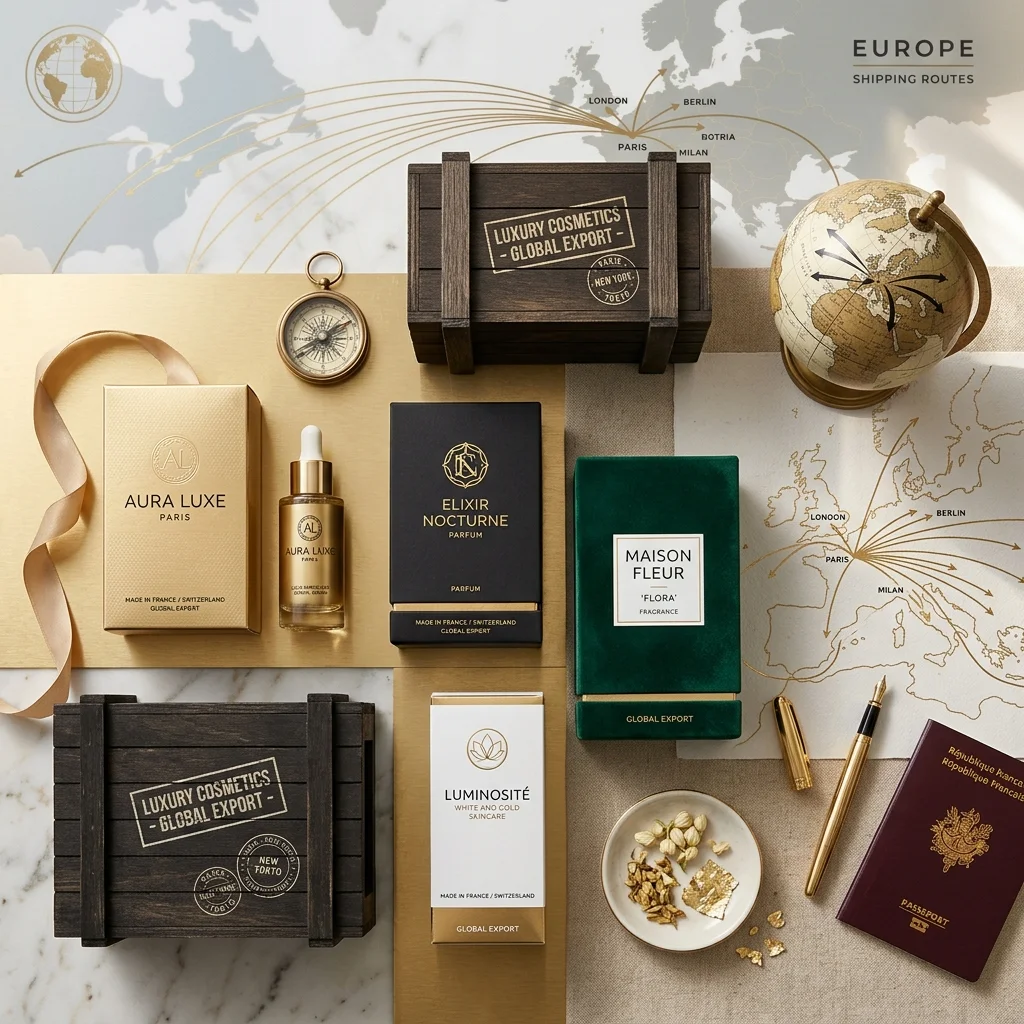
Exporting Private Label Fragrance Worldwide from Turkey
A practical guide for international buyers — what actually happens between your first enquiry and a delivered shipment.
Explore our private label perfume manufacturing in Turkey service.
Published 26 July 2026 · Kendi Markanda Parfüm
Every week we receive enquiries from brands, distributors and e-commerce sellers who want to produce fragrance under their own name and have it shipped to their market. Most of them ask the same three questions: how much do I have to order, how long does it take, and what do I need to prepare? This guide answers those questions in the order they actually come up in a real export project.
We are a private label and contract fragrance manufacturer based in Istanbul, Turkey. We produce perfume, cologne, room fragrance, scented candles and car fragrance under our clients' brands and export worldwide — to Europe, North and South America, the Arabian Peninsula (GCC), Africa and Asia-Pacific. If you want the service specification rather than the narrative, see our worldwide export page.
1. Why brands source fragrance from Turkey
Turkey sits between the two ends of the usual sourcing decision. Western European manufacturing offers proximity to EU markets but at a high cost base. Far Eastern manufacturing offers low unit costs but long lead times, high freight volatility and a supply chain that is difficult to supervise remotely.
Turkey combines a domestic supply chain — glass, caps, pumps, boxes, labels and essences are all produced locally — with short freight routes to Europe, the Middle East and North Africa. In practice that means fewer imported components in your product, shorter lead times, and a manufacturer you can reach in your own working hours if you are in EMEA.
There is also a cultural advantage that buyers often overlook. Turkish fragrance manufacturing has deep roots in both Western perfumery and oriental profiles such as oud, amber and musk. If you sell into more than one region — say a European e-commerce range and a Gulf retail range — one manufacturer can credibly produce both.
2. What you should prepare before the first message
The single biggest cause of slow quotations is an incomplete first enquiry. If you send the following six things together, you will usually get a realistic quotation on the first reply instead of four rounds of questions:
- Product group — perfume, cologne, room fragrance, candle or car fragrance.
- Target market and country — this determines labelling, documentation and often the fragrance direction.
- Quantity per variation — not the total, but how many units of each individual scent.
- Target retail price — this tells the manufacturer which quality tier of bottle, cap and essence to quote.
- Fragrance direction — a description, a reference you like, or a request for a custom signature scent.
- Packaging preference — ideally the actual model codes, which brings us to the next section.
3. Choose your bottle and cap before you even call
This is the step that saves international buyers the most time. You do not need to fly to Istanbul or wait for a printed catalogue to specify your packaging. Our full range is published online:
- 153 perfume bottle models — coded E1 to E153.
- 121 perfume cap models — coded EK1 to EK121.
- 29 cologne bottle codes — such as Code 501, Code 1002, Code 1501.
Browse the catalogues, note the codes you like — for example bottle E42 with cap EK17 — and send them with your enquiry. We then quote the exact combination you chose, including filling, labelling and packaging, rather than quoting a generic product you will later want to change.
Beyond the model itself, the usual customisation points are glass colour and coating, frosted or spray-painted finishes, cap material and plating, the closure system (crimp pump, screw pump, splash or spray), print or label decoration, and the folding box.
4. Minimum order quantity, and why it exists
Our minimum order quantity for export projects is 500 units for candles and up to 1,000 units for perfume and room fragrance, per variation. Buyers new to private label sometimes read this as a barrier, so it is worth explaining where it comes from.
A custom production run is not simply bottling an existing product. Bottles and caps are ordered in supplier-defined batches, labels and boxes have print setup costs, and the filling line has to be cleaned down and set up for your specific product. Below roughly a thousand units, those fixed costs dominate the unit price to the point where the product is no longer commercially viable for you.
Looking for manufacturing for your brand?
Share the product, quantity and target market; we will prepare a project-specific quote.
The important detail is that the MOQ applies per variation. A first order can combine several scents that share the same bottle, cap and box format — three scents at around a thousand units each is a far more common launch than a single scent at three thousand.
5. Sampling: the step that decides your timeline
Buyers usually ask how long production takes. In practice, production is rarely what determines the delivery date — sampling and approval are.
The sequence is: fragrance, bottle, cap, label and box are confirmed, a physical sample is produced, and it is sent to you for written approval. Only after approval is full production scheduled. Each revision — a scent that needs to be stronger, a cap in a different finish, a label correction — adds another round trip of production and international shipping.
The practical advice is simple: be decisive at the specification stage and make your revision requests in one consolidated round rather than several. Buyers who do this consistently get their shipments weeks earlier than those who send changes one at a time.
6. Compliance is destination-specific, not universal
There is no single global standard for fragrance products, and the requirements differ by product type as well as by country. In broad terms:
- Europe: perfume and cologne are cosmetics under Regulation (EC) No 1223/2009, which requires a Responsible Person established in the EU, CPNP notification and CLP-compliant labelling. Candles are not cosmetics — they follow CLP plus fire-safety standards (EN 15493, EN 15494, EN 15426). Room fragrances follow CLP with a safety data sheet.
- United States: FDA cosmetic labelling rules with INCI ingredient declaration; candles follow ASTM fire-safety guidance such as ASTM F2417. GS1 barcodes are needed for retail and for Amazon.
- Arabian Peninsula / GCC: GSO/GCC standards, with national bodies such as SFDA in Saudi Arabia and ESMA in the UAE, and Arabic labelling for retail.
- Africa and Asia-Pacific: requirements vary significantly by country and are planned per destination.
One point is frequently misunderstood: the manufacturer prepares the product, labelling and documentation to match the destination, but the importer or brand owner is normally the legal responsible party in the destination market. In the EU, for instance, the Responsible Person must be established in the EU — that is a role for you or your distributor, not something a Turkish factory can hold on your behalf. Clarify this early, because it affects your launch timeline more than production does.
Specific certification and registration requirements are confirmed per project. We do not publish unverified certificate or country claims.
7. Logistics and Incoterms
Shipments can be planned on EXW, FOB, CIF or DDP terms. Which one suits you depends on whether you have your own freight forwarder and how much of the process you want to control:
- EXW — you or your forwarder collect from our facility. Most control, most work for you.
- FOB — we handle export clearance and delivery to the port; you take over from there. The common choice for experienced importers.
- CIF — freight and insurance to your destination port are included in the price.
- DDP — delivered to your door with duties paid. Simplest for first-time importers, and usually the most expensive per unit.
Transport mode follows the destination: road freight is practical for Europe, sea freight (LCL or FCL) for the Americas, Africa and Asia, and air or courier for samples and urgent launches. Alcohol-based products are classified and packed according to the transport regulations for the chosen mode — worth knowing early, because it affects both cost and which carriers will take the consignment.
8. Common mistakes we see in export projects
- Choosing packaging before the price point. A heavy premium bottle on a mass-market retail price destroys the margin. Decide the retail price first, then the packaging tier.
- Ignoring shipping weight. Glass is heavy. On long sea routes a slightly lighter bottle can change the landed cost per unit noticeably.
- Leaving compliance to the end. Labelling requirements affect artwork, and artwork affects production. Raise the destination market in the first conversation.
- Ordering one scent only. Retail buyers and marketplaces generally respond better to a small coherent range than to a single product.
- Approving a sample from a photograph. Fragrance and finish must be assessed physically. Always approve the actual sample.
9. What the full process looks like
- Enquiry with product group, market, quantity and packaging codes.
- Consultation on positioning, fragrance and budget.
- Quotation including unit price, setup costs, Incoterm and lead time.
- Fragrance selection from the library, or custom development.
- Packaging specification fixed.
- Artwork prepared with destination-specific mandatory information and barcodes.
- Sample produced and approved in writing.
- Full production, filling, assembly and quality control.
- Export packing, palletisation and documentation.
- Shipment under the agreed Incoterm.
Frequently asked questions
How long does a private label fragrance export order take?
The timeline depends on how quickly fragrance and packaging decisions are made. Sampling and approval usually take the longest, because each revision adds a round trip. Production is scheduled after written sample approval, and shipping time then depends on the destination and transport mode.
What information should I prepare before contacting a fragrance manufacturer?
Your product group, target market and country, quantity per variation, target retail price, fragrance direction, and your bottle and cap preferences. Sending these together allows a realistic quotation on the first reply.
Is the minimum order quantity high?
It is a standard figure for custom private label production, because filling, packaging components and print all carry setup costs. It applies per fragrance variation, so a first order can combine several scents in the same packaging.
Who is responsible for compliance in the destination country?
The manufacturer prepares the product, labelling and documentation to match the destination, while the importer or brand owner is normally the legal responsible party in the destination market. In the EU, a Responsible Person established in the EU is required.
Start your project
If you already know your product group and target market — and ideally your bottle and cap codes — we can prepare an international quotation.
Request an international quotation See worldwide export details
Related reading
Looking for manufacturing for your brand?
Share the product, quantity and target market; we will prepare a project-specific quote.