Short Answer
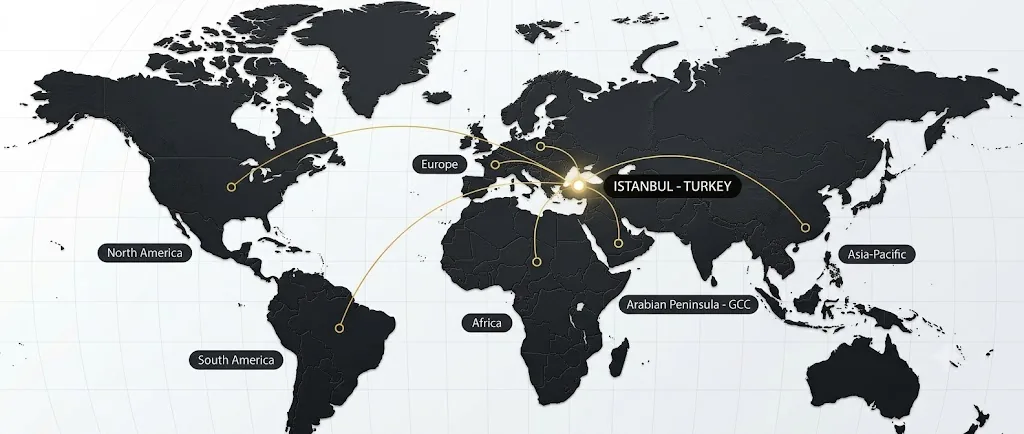
Turkey has become one of the fastest-growing sourcing bases for private label fragrance serving European, British and American brands. The reason is structural rather than promotional: Turkey sits inside the EU Customs Union for industrial goods, is 3-5 days from most European markets by road, and hosts a mature cosmetics manufacturing base with lower minimum order quantities than Western European contract manufacturers.
For an independent brand launching its first collection, that combination usually means lower entry cost than Western Europe and shorter, more controllable lead times than Asia.
Why Brands Source Fragrance from Turkey
1. Customs Union access to the EU
Industrial goods — including perfumes and cosmetics — move between Turkey and the EU under the Customs Union, using an A.TR movement certificate. For a UK buyer, the Turkey–UK Free Trade Agreement provides preferential treatment where origin rules are met. Compared with sourcing from outside Europe, this removes a duty layer and simplifies paperwork.
(Always confirm current tariff treatment with your customs broker before shipping — trade measures change.)
2. Lead time and proximity
Road freight from Turkey reaches most of continental Europe within days rather than the multi-week ocean transit from Asia. For a fragrance brand, this matters most in two moments: the sampling loop (where three fast rounds beat one slow one) and the restock cycle (where a bestseller selling out for eight weeks kills momentum).
3. Lower MOQs, real flexibility
Large Western European contract manufacturers typically serve established brands and set minimums accordingly. Turkish manufacturers more commonly work with emerging brands, offering stock bottle programmes and library fragrances that keep first-run quantities manageable.
4. Vertical integration
Many Turkish suppliers handle fragrance selection, compounding, filling, labelling, boxing and export documentation under one roof — and often produce candles, reed diffusers, car fresheners and cologne alongside perfume. For a brand building a scent family across categories, one supplier relationship replaces four.
Turkey vs. Western Europe vs. Asia: An Honest Comparison
| Criterion | Turkey | Western Europe | Asia |
|---|---|---|---|
| Typical MOQ for a new brand | Low to moderate | High | Low, but often per-component |
| Lead time to EU/UK | Short (road freight) | Shortest | Longest (ocean) |
| Duty into the EU | Customs Union (A.TR) | None (internal) | Duty applies |
| Sampling loop speed | Fast | Fastest | Slow |
| Perceived origin value | Neutral to positive | Highest ("Made in France/Italy") | Lowest |
| Documentation maturity | Good, verify per supplier | Highest | Highly variable |
| Cost level | Competitive | Highest | Lowest unit, higher landed |
The honest trade-off: if your brand story depends on "Made in France" as a marketing asset, Turkey is not your answer. If your brand story depends on the scent, the design and the margin, Turkey is frequently the better commercial decision.
What "Private Label" Actually Includes
A complete private label fragrance programme should cover:
- Fragrance selection — from the supplier's library, or bespoke development to your brief
- Concentration — EDT, EDP, extrait or cologne, set against your price point
- Maceration — the resting period after compounding; skipping it makes a scent open harsh
- Packaging — stock or custom bottle, cap, pump, collar, label, carton, cellophane
- Filling, crimping and labelling under your brand
- Batch documentation — lot numbers, certificates of analysis, retained reference sample
- Compliance pack — allergen declaration, IFRA conformity statement, safety data sheet, formulation data for your PIF
- Export documentation — commercial invoice, packing list, origin certificate, dangerous goods paperwork where applicable
If a quotation covers only items 1-5, you have a filling quote, not a private label programme.
The Compliance Layer You Own (and What Your Supplier Owns)
This is the most common misunderstanding in cross-border sourcing. A manufacturer in Turkey cannot be your EU or UK Responsible Person.
Looking for manufacturing for your brand?
Share the product, quantity and target market; we will prepare a project-specific quote.
| Responsibility | Usually the supplier | Usually the brand |
|---|---|---|
| Formulation and allergen data | ✅ | |
| IFRA conformity statement | ✅ | |
| Safety Data Sheet (SDS) | ✅ | |
| Certificate of analysis, batch records | ✅ | |
| Stability and compatibility testing | ✅ (on request) | |
| Cosmetic Product Safety Report (CPSR) | Sometimes arranged | ✅ Ultimately |
| EU Responsible Person + CPNP notification | ✅ | |
| UK Responsible Person + SCPN notification | ✅ | |
| US FDA facility registration & product listing (MoCRA) | Facility side | ✅ Product side |
| Artwork legal review, market claims | ✅ |
Agree this split in writing before production, not after the goods are on a truck.
This article is general guidance, not legal advice. Cosmetic and chemical regulations change frequently — verify current requirements for your target market before placing products on it.
Fifteen Questions to Ask Before You Place an Order
Capability
- Is production carried out in your own facility?
- Which categories do you produce in-house — perfume, cologne, candles, diffusers, car fresheners?
- What is your monthly capacity for my volume?
Fragrance and formula
- Can you send a scent sample kit before I commit?
- Do you offer bespoke development, and what is the timeline?
- Can I obtain exclusivity on a fragrance, and on what terms?
- Who owns the formula if we stop working together?
Consistency
- Do you retain an approved reference ("gold") sample?
- Will you send a pre-production sample for every repeat batch?
- What is your maceration period before filling?
Documentation
- Which of these can you supply: allergen declaration, IFRA statement, SDS, CoA, stability report?
- Have you previously supplied brands exporting to the EU, UK or US?
Commercial
- Is the MOQ per fragrance or per total order?
- Is packaging MOQ separate from filling MOQ?
- What does your quoted lead time actually include — sampling, packaging procurement, filling, or all three?
Red Flags
- A full production quote offered before any sample is sent
- Vague answers on formula ownership and exclusivity
- "You don't need those documents" as a response to a compliance request
- No retained reference sample — meaning batch two is a gamble
- A unit price far below the market: fragrance oil percentage is almost always where that saving comes from, and your customer will notice within two hours of wear
Frequently Asked Questions
Can I sell perfume made in Turkey in the EU? Yes. The place of manufacture does not have to be the EU. However, the product must be notified through the CPNP portal by an EU-established Responsible Person, and the Product Information File must be accessible within the EU.
Does an EU notification cover the UK? No. Great Britain operates a separate regime requiring a UK Responsible Person and a separate SCPN notification, with a UK address on the label.
What are typical minimum order quantities? MOQs depend on bottle type, number of fragrances and packaging choices. Stock bottles with library fragrances allow substantially lower first runs than custom moulds with bespoke formulation. Ask whether the MOQ is calculated per fragrance or across the whole order — the difference can double a three-scent launch budget.
How long does a first production run take? For projects using library fragrances and stock components, a realistic range is 8-14 weeks from first sample to finished goods. Bespoke formulation and custom bottle moulds extend this.
Can the same supplier produce my candles and diffusers? Where the supplier is vertically integrated, yes — and it is a significant advantage. One fragrance accord carried across perfume, candle, reed diffuser and car freshener builds a recognisable scent identity and consolidates your logistics.
Do perfumes need special shipping arrangements? Alcohol-based perfumes are treated as dangerous goods in transport, with specific packaging, labelling and documentation requirements, and limited-quantity provisions. Plan this before you promise air delivery to end customers.
Start with a Sample, Not a Contract
kendimarkandaparfum.com produces perfume, cologne, room fragrance, car fragrance and candles under our clients' own brands, with export-ready documentation for EU, UK and US markets.
👉 Tell us your category, volume and target market — we'll send a sample kit and a full quotation.